Southern Pacific Lines
Coast Line Division
“The Route of the Octopus”

Southern Pacific Lines
Coast Line Division
“The Route of the Octopus”

Reefer Operations
Refrigeration for the Produce Shipments by Tony Thompson
There are considerable formalities to tariff and regulatory aspects of railroad refrigeration. But to summarize briefly, empty reefers were delivered to shippers either with ice already in the bunkers (called pre-icing) or without ice. Which one was specified by the shipper depended on the crop being shipped, and of course on the climate at that point in the harvest season. After loading, nearly all produce cars were iced (called initial icing) unless moving in ventilation service.
Pre-Cooling Cargo
Part of the decision on a shipper’s part about pre-icing was whether the produce could be cooled before loading (called pre-cooling). If the lading could be pre-cooled, then it was not usually necessary to order a pre-iced car, not only saving the icing cost but assuring the shipper better control of the shipping temperature of the cargo. The reason for the latter statement is that any produce needed to have the “field heat” removed. Removing the field heat slowed or stopped ripening and assured that the produce would reach its destination in condition to be sold.
Putting produce into a reefer direct from the field or orchard meant that field heat had to be removed during the first 24 to 30 hours of shipping, as ice melting gradually absorbed heat from the warm air rising from the cargo. This was speeded if the ice melt did not also have to absorb heat from a warm car body,
So what was pre-cooling? It might be nothing more than placing the packed produce in a cooled room overnight. For dense produce like melons or citrus or apples, dunking the produce in a stream of cold water before packing might suffice for pre-cooling. With leafy vegetables like spinach or lettuce, misting them with water and then subjecting them to a partial vacuum would provide greatly accelerated evaporation and thus cooling (called vacuum pre-cooling). The shipper, of course, chose what was feasible and economic for his particular crop.
Non-Icing Reefers
Initially at an agriculture platform, one or two reefers will be sitting and the farm trucks pull up and load produce into the cars. Once a day a little Mogul comes and drags reefer(s) into the small yard and sets them out for the mainline pickup.
These reefers out in the ag belt don't have ice in them. They won't have ice until that mainline train pulls them into an icing platform. So the empties that are dropped off for placement out in the countryside don't have ice either. Timing was crucial on these old reefers and there was a limited time the produce could sit in that car without ice.
Pre-Icing Reefers
Empty cars might be pre-iced, that is, have ice in the bunkers to cool the car somewhat. The reefer had to be set to an ice deck before spotting at the shipper’s loading dock. The desire to pre-ice cars was there was a chance the empty car might be warm when delivered. Depending on the ag. most cars would be pre-iced. Later on they developed the process of pre-cooling. Cars could be stuck in a freezer and iced to bring inside temp down to a prescribed temp, and then sent out. The car would remain cool until doors were opened at packing plant. Cars were packed, say in an hour or two, and the doors were closed. A couple tons of ice is not going to melt real fast, though the field heat of the ag would greatly speed process. Once picked up, reefers were re-iced at the icing platform to keep the temp down.
Initial Icing Reefers
After loading, nearly all produce cars were iced (called initial icing) unless moving in ventilation service.
Re- Icing Reefers
En route to destination, cars were usually re-iced at intervals such as 24 hours (shippers could specify any interval they wanted). Often the 5000 pounds of ice in each ice bunker would be depleted by 1000 to 2000 pounds in 24 hours during normal summer transit weather. The bunker would be refilled and the shipper billed for the amount of ice used.
Top Icing Reefers
Top icing is what they call when ice was sprayed on top of a load. Back in the late 1950’s, a PFE car on the Pacific Electric had been loaded with celery. There were two trucks from the Union Ice Company. One of the trucks was loaded with ice and was backed up to the other truck that had a device on it that would grind up the ice and blow the ice through a large hose onto the refrigerator car.
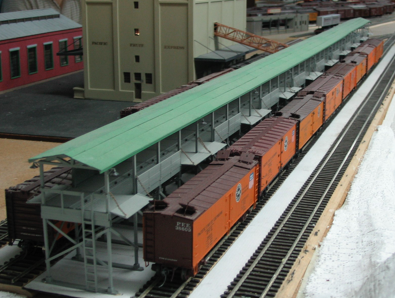
Icing the cars was also done with a portable conveyor truck. The conveyor would be located somewhat in the middle of the car. This way they can get the 300 lb block of ice on the roof walk and then slide to either end of the car and fill either side. The ends of the cars were hollow and filled with blocks of ice. The cold air was circulated when the car was moving by a chain-driven fan connected to the axle. Since fiberglass insulation didn't exist yet, the cars were insulated with cork. During the summer larger rail yards such as Fresno hired football players from the local college who wanted to "stay in shape" during the off season.
Ventilation Service
Shippers might also choose ventilation service instead of refrigeration, in other words to have the ice hatches latched open so that surrounding air would blow through the car in transit. Obviously this would only be done if temperatures en route were expected to fall into the desired range.
Reference
Go to: http://modelingthesp.blogspot.com/2011/06/few-words-on-packing-houses-and-produce.html
Pacific Fruit Express, “Western Perishables” chapter, (Thompson, Church, and Jones, Signature Press, 2nd edition, 2000
“Protective Services” by Tony Thompson
Details of car operations and what is called “protective services,” meaning icing or other service to protect the load. These services occur during the time of ice refrigeration.
Ice refrigerator cars had ice bunkers capable of holding around 10,000 pounds of ice, 5000 in each bunker. There were two ice hatches at each end of the car, but they opened into a single bunker at each end. The melting of ice consumes a great deal of heat. That in turn can rapidly cool the cargo in a car, or easily maintain a low temperature in the face of high external temperatures. Early mechanical reefers, in the period, say, from 1953 to 1960, were only suitable for loads which were already cold, such as frozen food, but did not have the capacity to cool a warm cargo sufficiently quickly.
The typical ice reefer was loaded at a shipper’s dock, then switched to an icing facility to fill the ice bunkers. Thereafter, it would be iced en route to market “as needed.” Often re-icing took place every 24 hours, but the interval could be specified by the shipper to be more often or less often, depending on estimates of en route outside temperatures. In re-icing, bunkers were simply refilled to the top, often taking several thousand pounds per bunker. At the ice deck, foremen with experience could estimate by eye the amount of ice which would be needed to fill the bunker, and the cost of that ice was charged to the shipper.
A shipper could order a car “pre-iced.” This means that the empty car had its ice bunkers filled before it was spotted at the shipper’s dock. This would help cool a hot car, in summer weather; and as the produce was loaded into the car, perhaps still warm from the field, there would be cold air inside, to start cooling the load toward its shipping temperature. But if the shipper was precooling his shipments in his own facility, there was much less need for pre-icing the car, and he would not want to pay for the pre-icing service. Note the terminology: that cars were pre-iced, loads were pre-cooled. This is the tariff language.
Once the car was loaded and picked up by a switch crew, it would be “initial iced,” meaning filling the bunker, whether or not it had been pre-iced. It would then head off toward market, being re-iced as needed in transit, perhaps several times if moving all the way across the country.
Ice was placed in bunkers and done with three possible sizes of the ice. These were as follows: “chunk,” meaning not more than 75 pounds per piece (a standard PFE ice block weighed 300 pounds, so that is a quarter of a block); “coarse,” meaning about the size of a melon, 10- to 20-pound pieces; and “crushed,” meaning about the size of a man’s fist. Any smaller than that, and there would not be large enough air spaces among the ice pieces to permit good air circulation, which of course was essential so that cold air from the bunker could move freely into the load space and displace warm air. But full 300-pound blocks were not placed directly in bunkers.
Other icing services included “top icing,” which involved blowing finely crushed ice across the top of the load inside the car, a good way to keep leafy vegetables moist in transit, and “body icing,” in which blocks of ice were placed among the boxes of produce. Some en-route icing stations could provide re-top-icing services.
Modeling “Protective Services”
These prototype details can be the basis for modeled operations and paperwork, such as waybills. Personally, I like to include what I can of prototype practices like these in the way I operate my layout.
PFE Reefer Westbound LCL Shipments
According to a Fall 1947 UP Wheel Report for cars between Laramie & Rawlins WY, about 30% or 43 of the 145 westbound LCL carloadings were in reefers. 75% of these reefers were owned by PFE. 31 of the LCL-toting reefers were owned by PFE while another five were owned by SFRD.
In New England, the Union Pacific would allow under certain conditions the use of empty PFE reefers to be used for loading of "dry" freight to points on their lines. For instance if a shipper was to load a "stop off" box car that for example would be loaded in Providence RI and stopped off at Salt Lake City for partial unloading with final unloading in Los Angles, two reefers could be used instead, with one car loaded for Salt Lake and the other for LA. This would improve transit time.
Permission had to be obtained by the originating railroad and the Waybill endorsed (Reefers used in lieu of box car). This would mean that PFE reefers would be seen on a siding of a customer that shipped or received nonperishable freight.
Railroad were not eager to run their produce reefers back home empty unless they were in great demand for another trip east. In less harried seasons, common dry loads would include newspapers and magazines from East Coast publishers, all manner of clean items, such as canned goods and boxed items, or LCL shipments from people like the mail order houses in Chicago or Kansas City. A railroad would normally substitute 2-3 reefers for one boxcar, which was ideal for LCL shippers. Santa Fe developed the Mahoney transload facility near the west end of Argentine Yard in Kansas City. Box cars of LCL goods were brought to Mahoney where they were transloaded into reefers for various western destinations. Of course empty reefers or those hauling nonperishable freight could be found anywhere in the train, not just at the headend.
One drawback to using reefers as boxcars was the door width. Most railroads had 4' doors. Loading was by hand truck. The sliding plug door first appeared on Santa Fe cars in 1949, helped make the inside more accessible to fork lift trucks. This was the same period where box cars were moving from 6' to 8' doors.
During the holiday season in the early 50s, Santa Fe ran a daily train of approximately 60 reefers between Chicago and California operating on passenger schedules. The cars carried westbound Christmas express traffic and bulk mail.
Depending on the seasonal needs, empty reefers from one railroad could be moved to another to handle reefer shortages.
Reefers were used in LCL service only when there was a boxcar shortage. Reefers were substituted in LCL service for boxcars in Chicago, Kansas City and other points in the Mid West in order to provide primarily a supply of empty boxcars for grain loading.
The three reefers for one boxcar rule pertained only for carload lots which specified a minimum weight to qualify for the carload lower rate.
There was no minimum weight for an LCL car except during WW II. (Exception: During WW II when there was a minimum ten ton weight for loading an LCL car, the three reefer for one boxcar provision was applied to LCL cars.)
Boxcars were preferred in LCL service because of wider doors than reefers. Also, the hinged doors of reefers required greater clearance when loading (or unloading) through car doors on adjacent parallel tracks without platforms than the sliding doors of boxcars. If clearances were too tight, the doors of reefers would have to be opened before the car was set for unloading and closed after the car was pulled with a load.
Another complication using reefers in LCL service was that they could be routed only in one direction vs. a boxcar which could be sent almost anywhere - car rules about reloading empties only in the direction of their home road was largely ignored, and no where more than in LCL service.
Once a boxcar was put into LCL service, it was apt to stay in it for a while until that boxcar was unloaded at a station which could not reload it. Refer to the routing of C&O #1 in Mono's ad on pages 56-57 of the September 1948 TRAINS magazine. #1 was loaded in Crawfordsville IN on June 16th, 1947 and remained in LCL service until July 16th, 1947 traveling to Louisville KY, Montgomery AL, Miami FL, Savannah GA, Atlanta GA, Macon GA, and Hamlet NC before being spun out of LCL service near Columbia SC. There was no such luxury with reefers. Their services were required near the fields to ship their produce to eastern markets.
To load LCL into reefers required somewhat specialized procedures. LCL was hauled by truck from the Argentine transfer house to to the Mahoney Transfer facility at the western end of the Yard. The unloaded boxcars at the Transfer were utilized for the seasonal grain rush in primarily rural Kansas.
C&NW's Proviso Transfer was also had the capability to use reefers in LCL service without upsetting much the LCL unloading/loading function. First of all, incoming LCL was unloaded on separate tracks than those used for outbound load. Cars on each inbound and outbound track could be served directly from a platform which meant packages did not have to be hauled through a multitude of car doors on parallel tracks. Because of these platforms, a string of reefers could be set on one track, loaded for certain points to the west, and could be pulled somewhat more independently than for a station where loading was done through car doors on adjacent tracks where one pull could shut down loading operations for the entire freight house.
Grab a copy of "The Great Yellow Fleet" to compare how the rest of the US used and moved reefers (the freight car types of reefers that is). But don't trust the info later than 1920, which is approximately where the informed and knowledgeable contributions of Jack White stopped, and the opposite-character contributions of Don Duke started. In particular, don't trust photo captions, as Duke wrote most of them. Anyone wanting more on the shortcomings of this book, an account is in the archives.
Tony Thompson
West Bound Reefer Loads
A number of different types of goods were transported in west bound reefers. But without specific waybills we will never know what was shipped in the various trains.
"Besides LCL, there were commodities which could be carried in car load lots on westbound. Among the westbound commodities carried on the UP between Laramie & Rawlins in the Fall of 1947 according to a Conductor's Wheel Report was produce not produced in the Far West - Bananas, Grapefruit, et al.; beverages; canned goods; as well as wool, machinery, appliances, tires."
California produced produce was seasonal just like the rest of the country. The growing season for Citrus in Texas and Arizona are similar as Calif. In Yuma AZ the growing seasons are somewhat different then the coastal areas.
Bananas went via New Orleans instead of Long Beach or Oakland.
There was a depression in the lumber industry during 1924 and Fruit Growers Supply (buying arm of the California Fruit Growers Exchange) purchased a large amount of its shook needs on the open market. At the time the "Supply" company operated two box factories, one at Hilt, California the other at Susanville, California.
References
The Sunkist book lacks an index. The current Sunkist website list the following:
Southern Arizona Citrus Exchange Von Verde Citrus Packinghouse
Marlin Packing Company Rancho Del Sol LLC
(b) Marlin Growers, Inc. (c) Rancho Del Sol Growers
Yuma Mesa Fruit Growers Association
Reefer Team Tracks
Reefers were loaded and top iced on the team track on the westside of the Santa Ana, Ca. Santa Fe station in the 1950-1960s. More recently (during the 1980s)the Santa Fe had FGEX reefers loaded on the team track ramp at Riverside. The fruit was trucked to the site and transloaded there. Royal Citrus packing house did the loading, since they didn't have a good siding location on the Santa Fe. At the time the SP had direct service to Royal Loading directly into car on the AT&SF was avoid delays caused be interchanging cars locally in So Cal.
A photograph on Trainorders.com showed several Great Northern Express Reefers at the Packing House across from the Santa Ana, Santa Fe station. The GN cars were being reloaded to head north or maybe to Chicago after delivering some food product to LA area.
Spotting Empty Reefers
An ATSF freight car conductor in the mid 1950’s mentioned that spotting empty reefers (if already iced they were referred to as Icers) at a packing house they first stopped their train at the station--with the caboose closest to the station--and the conductor would receive from the agent on duty a list of cars to be spotted at the specific packing house. In addition his instruction from the shippers would specify at which doors to spot those reefers. Those packing houses had a door number above each door in use for loading. Jim Lancaster's packing house web site has examples such as the Orange Co-op Citrus Assn. in Orange, Ca. If the agent were not on duty he would have left detailed instructions in the way bill box attached to the front of the depot. This would open with a switch lock key to provide the conductor with a list of moves they were to make. The train would usually be backed down so the engine was opposite the depot and the crew would discuss how best to accomplish the work. If the job was to take some time they might decide to break off and "go to beans"--dinner then return for two to three hours of work. One other challenge to the crews could be that a packing house might not have completed loading the car when it's crew went home for the night. This partially loaded car referred to as a "baby load" would usually have to be repotted back at the same door where it had been located before making all the other moves.
Reefer Movements & Shipment Diversions
The term "diversions" has surfaced several times in research of reefer movements. Because perishable prices fluctuated widely in the various regional markets, shippers were allowed to divert reefers en route from their original destination to locations, which might offer higher prices. Three such diversions per car were permitted without charge, and most shippers took full advantage of this policy. Diversions alone, therefore, kept a small army of clerks busy at the keyboards of typewriters and Teletype machines. "
In the case of Florida perishables, research pertains to the movement of Florida Citrus for the years 1947 through 1950 notes, "About half of the perishables sent from Florida were shipped before the sale was made. In these cases, the shipper consigned the car to himself to some diversion point (on the SAL, Jacksonville, Savannah, Richmond or Pot Yard - to this list may be added Waycross for the ACL). Diversion (and / or reconsignment) allowed the shipper (or reconsignee) to delay choosing which market would provide the best price. Southeastern railroads permitted three free diversions or reconsignments without charge. When a reconsignment occurred, a new waybill was made; a diversion without a change in ownership merely required the destination in shown in the waybill changed. Florida shippers, however, had less time to canvass the markets than the California shippers."
Another expensive service incident to the transportation of fresh fruits and vegetables is the performance of diversions, which are very extensive on the Santa Fe and on other origin lines. The perishable tariffs authorize three free diversions, which may consist of change in destination or route or both. Most of the free diversions are taken in the West, relatively few in the East, and it is my belief that more of them are taken on our line than our Midwestern connections. Aside from the telegraphing and clerical work involved in handling these 43,581 diversions, considerable additional switching was required. As a check on the amount of additional switching performed in connection with diversions, we took a random sample by car numbers of diversions at Belen in 1954, the sample comprising 1,294 cars. Of that number, 204, or approximately 16 per cent, required switching in excess of ordinary handling. Applied to the total of 43,581 diversions, this indicates performance of extra switching service on account of diversions on over 6,800 cars in 1954. In addition to diversions involving change of destination or route, shippers may order a change in the name of consignee, a privilege which is availed of to a great extent on our line. While not causing any additional switching, these reconsignments require a tremendous amount of telegraph and clerical service.
Fridge Car Tags
The cleaned refrigerator cars had a paper tag tacked on to the wood holder on the side of the car that stated that it was cleaned and ready for loading. They had date, location and inspector written on the card. The Santa Fe used a card with several sides that had different conditions printed on it and the one that applied had info filled in and tack upright on the car. The cards were used to indicate pre-iced cars. These "car ready for loading" tags were used for other types of cars. A tag on PFE cars had CLEANED on it.
Open Ice Hatches
PFE cars were not operated with hatches open unless they were in vent (ventilation) service. Under ventilation only orders, empty cars spotted at packing houses, had the hatches up until they were iced. The cars were spotted dry and iced by the packing house before delivery to shippers. There were not pre-iced by PFE. An example of loaded cars, perhaps from Guadalupe packing sheds or picked up in interchange from the Santa Maria Valley at Guadalupe, would show reefers with open hatches.
PFE reefers in the 1960s had ice hatches open on empty, dry cars. There is a reference to sealing the hatches when the cleaning process was finished in the PFE book, but that was not the practice by the 60s.
Tony Thompson
Hauler Train Make-up
On the Watsonville - Salinas Hauler during 1948 to 1952, these were naturally reefers in most cases, but they also handled trains of loaded and empty cars of sugar beets destined to and from Spreckels. 76%, were PFE cars. Much more surprising was that 122 cars, or 11%, were ART cars.
In a conductor’s train book, it was noted that the surprising finding that only about three-fourths of the refrigerator cars were PFE cars, but that this reflects conditions at peak harvest time. Most of the year PFE was able to cover nearly 100 percent of its car needs with its own fleet.
Tony Thompson
PFE Flatcars
In the 1960's, PFE owned a series of 85' flats. These cars built by PS.
Info is tight, even in Tony's book. Some of the renumberings may never be fully documented.
Lee A. Gautreaux
PFE F-70-17 Flatcars
PFE F-70-30 / 31 Flatcars
89' cars: http://www.railgoat.railfan.net/spcars/byclass/flat/f070-30.htm
http://www.railgoat.railfan.net/spcars/byclass/flat/f070-31.htm